Jacob lived alone at the edge of a forest no one cared to name, in a house that had forgotten what it meant to be a home. It stood lonely and decrepit, almost like a skeleton with loose skin. The walls of the house had never seen a second coat of paint ever since its inception. Hung on them were sepia tinged photographs which spoke of happier times and a fuller family. But the dust of time had made them unrecognisable now.
He rarely left his house. Never in fact except a monthly visit to the town centre for his groceries. Everyone knew him as the strange loner who stayed by himself in the house by the woods. He liked it that way. Solitary. He typed on his battered laptop and sent his writings to a local newsletter. That was his only contact with the rest of the world.
Inside, silence reigned—a silence so deep and heavy that it felt alive, pressing against the walls, seeping into the cracks, and gnawing at Jacob’s thoughts. The occasional creak of the floorboards or the faint scratching of unseen creatures burrowing in the walls only served to accentuate the oppressive stillness.
But there was one place Jacob refused to think about: the basement.
He avoided the door, a warped relic at the far end of the kitchen. Its chipped surface seemed to pulse with its own life, an unspoken warning to leave it untouched. He didn’t know why, but he’d never set foot down there, not in all the years he’d lived in the house.
The first time he heard the voices, he convinced himself it was the wind. A faint, fragmented murmuring that wove through the cracks of the house like a thread pulled taut. But the wind didn’t sound like that. The wind didn’t whisper your name.
“Jacob…”
At first, he laughed it off, shaking his head as he turned up the volume on the old radio in the corner. The jazz station crackled and hummed, filling the kitchen with static-laden notes. But even then, beneath the music, the voices persisted—soft, insistent.
“Jacob… come down.”
It wasn’t just one voice. It was many, overlapping and layered, a fractured symphony of murmurs that seemed to rise from the floor itself. He told himself it was nothing, the product of loneliness or the house settling into itself.
But the whispers grew bolder.
By the second week, Jacob began to notice other things. Objects he was certain he’d left in one place would appear somewhere else. The chair at the kitchen table, which he’d pushed in after dinner, was slightly askew the next morning. His keys, always left on the countertop, were found on the floor.
And the smell.
It started faint, like something forgotten and rotting in the walls, but grew stronger by the day. It wafted up from beneath the basement door—a cloying, sickly-sweet stench that clawed at the back of his throat.
“Just a raccoon,” he muttered to himself one morning, staring at the door with bloodshot eyes. “Got in through the vents. That’s all it is.”
But the whispers grew louder.
“You know what you did.”
“Come down, Jacob. Face it.”
At night, he pressed pillows against his ears, but the voices seeped inside his head, rooting themselves like parasites. Sleep became a memory, and Jacob stumbled through his days in a haze, his mind unraveling thread by thread.
And then, one storm-drenched night, the whispers turned into screams.
They rose like a gale, rattling the windows and shaking the foundation of the house. Jacob bolted upright in bed, his heart hammering in his chest.
“COME DOWN, JACOB!”
The walls seemed to reverberate with the command, and something in him snapped. He couldn’t take it anymore. With trembling hands, he grabbed a flashlight and stumbled into the kitchen, his bare feet slapping hard against the cold tile floor.
The basement door loomed before him, warped and swollen with years of humidity. The smell hit him like a punch, strong and disgusting, nearly driving him to his knees.
He yanked the door open.
The darkness beyond was complete, a void that seemed to stretch infinitely downward. He hesitated at the top of the stairs, the flashlight trembling in his grip.
“Come closer, Jacob.”
The voices were no longer whispers; they were a chorus now, rising and falling like the tide. His breath hitched as he descended, each creaking step drawing him closer to whatever waited below.
At the bottom, the stench was suffocating. The beam of his flashlight cut through the thick air, illuminating nothing but cobwebs and dust. The basement was empty—or so it seemed.
But then he saw it.
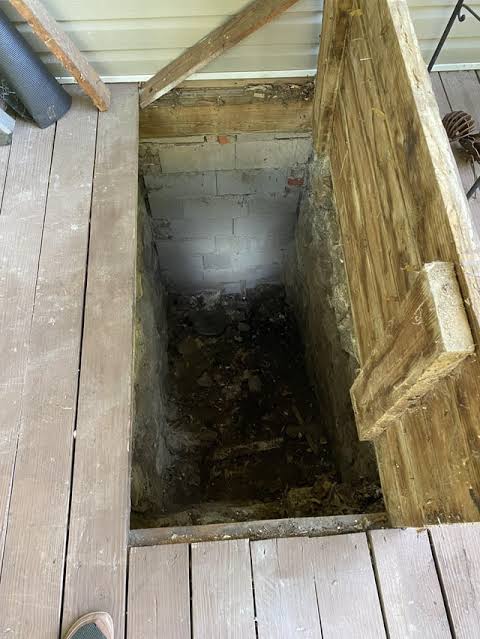
In the far corner, beneath a pile of rotting wood, something pale protruded from the dirt. He froze, his flashlight shaking as the beam flickered across it. A hand.
The whispers erupted into laughter, cold and hollow.
“You forgot, didn’t you?”
“Look closer.”
His legs felt like jelly as he approached the corner, his mind screaming at him to turn back. With shaking hands, he moved the wood aside. The dirt beneath was loose, disturbed. And then he saw more—a second hand, curled and skeletal, clawing its way toward the surface.
Memories came flooding back, sharp and merciless.
The woman at the bar. Her laughter. The fight. The way her head had struck the counter, the sickening crack of bone. The frantic digging in the dead of night, his hands caked in blood and soil.
But it wasn’t just her. There had been others. So many others.
“No,” he choked, staggering backward. “No, no, no…”
The dirt began to shift. Hands—dozens of them—emerged from the earth, clawing upward. Faces followed, eyeless and rotted, their mouths stretched wide in silent screams.
“You buried us, Jacob.”
“All of us.”
He turned and bolted up the stairs, his heart hammering against his ribs. The voices rose behind him, a wall of sound that seemed to chase him through the house.
By the time he reached the kitchen, he could barely breathe. He slammed the basement door shut and sank to the floor, his body trembling.
But the whispers didn’t stop.
Days passed, and the house fell silent. When the townsfolk finally arrived to check on Jacob, drawn by the absence of his monthly trips for supplies, they found the house abandoned.
Inside, the air was thick and stagnant. The kitchen table was set for one, the chair neatly pushed in. But the basement door hung ajar, the darkness beyond it yawning wide.
In the corner of the basement, beneath the disturbed earth, something shifted.
A hand reached up.
And then another.
Copyright (c) Pratik Majumdar, 2024. Any article, story, write-up cannot be reproduced in its entirety or in part, without permission. URL links can be used
 Words are flowing out...
Scary !!!!
LikeLiked by 1 person
🙂
LikeLike