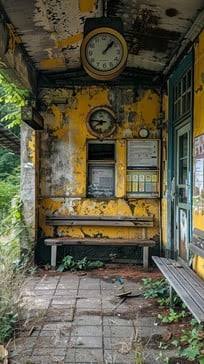
The railway station was almost forgotten—by the trains, by time, by the world. The tiles were cracked like old skin, the signs faded to near whispers of color, and the air tasted of rust and dampness. Weeds rose defiantly through the tracks, stubborn and alive in a place long left behind.
Morning light spilled across the station with gentle grace. A distant train horn called out somewhere far beyond the horizon and dissolved into silence.
Rajan sat alone on a rusting bench. He was in his late fifties, his salt-and-pepper hair swept back, his eyes lined by time and memory. A denim shirt hung loose on his frame. Beside him, a cloth bag—soft from use, fraying at the edges. His gaze stretched far beyond the tracks, past the emptiness, into something unseen. He didn’t look at his watch. He already knew no train was coming.
The hours passed like clouds. By afternoon, a quiet shuffling echoed through the station’s long corridor. Meera entered with the kind of grace life gives only after it’s knocked you down and helped you stand again. She was in her early sixties, dressed simply, elegantly. Her silver-streaked hair was tied back, and she carried a small flask tucked into the crook of her arm.
She found her seat beneath the old station speaker. As she sat, the speaker crackled to life.
“Train number one-zero-two-four, arriving on platform number two…”
She mouthed the announcement silently, her lips forming each familiar word. Then, her eyes closed, a faint smile touching her mouth. As if for a few seconds, the station became a temple, and the voice—prayer.
Days passed.
Rajan unfolded the same letter each day, its paper worn soft like cloth. He read it slowly, reverently.
Meera would sit in her usual spot, eyes closed, head tilted slightly toward the speaker. When the announcement came, she’d smile faintly, whisper it along.
A heavy rain came one day. The monsoon let loose a curtain of silver. Rajan stayed exactly where he always did, letting the rain stitch cold into his shoulders.
Another day, Meera poured tea from her flask into two small cups. One, she sipped from. The other sat beside her, untouched, steam curling into the air like memory.
Sometimes, they made brief eye contact across the platform. A soft nod. No words. Just two people caught in the same kind of quiet.
One rainy afternoon, the rhythm of the rain slowed, as if hesitant to interrupt.
Rajan turned toward her, finally speaking.
“Do you ever wait for someone… who’s already gone?”
She looked at him. Not startled. Just… seen. As if she’d asked herself the same question before.
“Every single day,” Meera said.
He breathed in, the air damp and heavy.
“My wife,” he began, his voice steady, “left after a fight. Walked out with just a small bag. Two weeks later, I got a letter. She said she just needed time. Said she’d be back.”
He paused. Looked out across the tracks.
“It’s been nine years.”
Meera’s eyes found the speaker above them. Her voice was soft.
“My husband worked for the railways. He was the voice of this station. Every announcement… that’s him. Still. All these years later.”
She smiled gently. “It’s the only place I can still hear him.”
They didn’t speak after that. But the silence wasn’t empty anymore.
More days. More gentle rituals.
Rajan shared a piece of paratha from his tiffin. Meera accepted it without ceremony.
Meera laid a shawl on the bench beside Rajan on a cool day, smoothing the fabric like memory.
When the speaker called out, she closed her eyes. Rajan always looked away, as if respecting something sacred.
One afternoon, Rajan opened a worn photo. A woman laughing, wind tugging at her hair. She looked too alive to ever leave.
“She loved trains,” he said. “Said they sounded like freedom.”
Meera smiled. “And you?”
“I only loved them… because she did.”
One quiet evening, Meera brought a small recorder—old, chipped. She set it beside her, clicked a button.
“Train number one-zero-two-four, arriving on platform number two…”
The same voice. The same cadence.
A tear slipped down her cheek. She didn’t wipe it away.
Rajan reached out slowly, placing his hand near hers—not touching, just close enough to share warmth. She didn’t move it.
Sunset turned the station golden. The sky dimmed. The speaker crackled again, softer now.
They sat side by side, the space between them gently filled with understanding.
A distant train called out again—a sound like memory, or maybe promise.
Rajan turned to her.
“Do you think… it’s okay to love someone again?” he asked, his voice uncertain, vulnerable. “Even when your heart is still… somewhere else?”
Meera looked at him, her eyes calm, kind, filled with the clarity only time can offer.
“I think it’s the only way we ever really love,” she said. “Never replacing. Just… holding space for more.”
The train passed through in the distance, its light carving through the dusk. But they didn’t move. They stayed seated. Together.
Above them, the announcement echoed again.
“Train number one-zero-two-four, arriving on platform number two…”
Meera looked up. Rajan watched her.
Somewhere between grief and healing, between memory and hope, they remained—two souls in a quiet station, no longer waiting alone.
Some hearts never stop waiting.
Some souls never stop arriving.
Copyright (c) Pratik Majumdar, 2025. Any article, story, write-up cannot be reproduced in its entirety or in part, without permission. URL links can be used
 Words are flowing out...
Very well written with maturity .Keeps up the interest and curiosity . Look forward to more. My Best wishes to you.
LikeLiked by 2 people
Thank you so much Uncle for your kind words 🙂
LikeLike